When a qualified machine can be outdated before production even starts, qualification must plan for change instead of freezing one configuration.
I attended several talks over four days at ICAM 2026, and Additive Manufacturing (AM) qualification came up repeatedly: in keynotes on aerospace production, in sessions on machines and feedstock, and in standards discussions.
By qualification, I mean the evidence that a defined combination of feedstock, machine, process, and post-processing produces material and parts that perform consistently against their specifications. In metal AM, the material and the part are made at the same time, so these elements cannot be qualified independently.
Prabhjot Singh framed the problem well in his RTX keynote. Laser power has been doubling and build volume tripling roughly every four years, so a machine qualified today may be outdated by the time production starts. Production sites also run different machine configurations, and manufacturers need the flexibility to add powder suppliers.
My main takeaway is that qualification increasingly has to account for change. What end users ask for is stability and predictability.
The practical questions are which changes affect part performance, and what evidence is enough to establish equivalency after a change. I look at these questions from the feedstock side, where every process change must be documented, justified, and accepted by the customer before it reaches a part.
In brief:
- Machines are changing faster than qualification cycles. Frameworks such as RTX’s Q3+ scale the qualification response to the size of the change.
- In JMADD results for Ti-6Al-4V reported by the FAA, powder chemistry drove strength and ductility more than the machine did. Material specifications need to control the powder attributes that matter.
- Multi-laser productivity gains shift qualification risk toward fatigue performance in laser overlap regions.
How Additive Manufacturing qualification supports production across machines
A parameter set qualified on one machine is a useful starting point, but its results cannot be assumed to transfer to another system. Machine installation and calibration, laser configuration, feedstock, part geometry and the inspection approach all affect the intended outcome. In production, these variables must be controlled together, as one process.
In the same keynote, Singh described Q3+, a framework RTX applies internally and to its suppliers. It separates qualification into four steps:
- Equipment qualification (EQ): the machine meets defined requirements.
- Operational qualification (OQ): the machine and process operate within established limits.
- Material qualification (MQ): the printed material meets its specification and supports the design values.
- Part qualification (PQ): the part meets its drawing and specification requirements.
The value of this separation is that a change does not automatically trigger full requalification. A new or recalibrated machine is addressed at the OQ level, which is then divided into different levels according to the size of the change.
Brian Fisher (RTX) explained the reasoning in a later session. Material qualification costs millions of dollars, so RTX pushes risk upstream through rigorous machine calibration, including as-found and as-left checks, so that more machines can share one material qualification.
Mike Kenworthy (VulcanForms) went further in his keynote. He argued that a frozen parameter set is a compromise for a large, mixed fleet, and that qualification should rest on validated process windows supported by in-situ monitoring data, rather than on one fixed build recipe. Christian Seidel (Wohlers Associates) gave an example of the cost of staying frozen: ring-shaped beams can be up to six times faster on bulky parts, but they are hard to qualify under current approaches.
Both approaches aim at the same outcome: evidence that shows whether a change needs full requalification or a focused demonstration of equivalency.
Material qualification starts with controlled feedstock
Part producers are asking for qualified process windows on the machine side. Meanwhile, as Rodney Jones (GE Aerospace) described, powder is controlled through frozen processes at the supplier, and every change goes through the customer’s engineering and quality review. For a powder producer, that frozen process is defined in process control documentation (PCD): a set of controlled documents showing that production controls are in place.
Several talks showed why feedstock carries so much weight in qualification. Cindy Ashforth (FAA) presented lessons from the Joint Metal Additive Database Definition (JMADD) program.
MADD addressed the lack of public, statistically based allowables for L-PBF Ti-6Al-4V. The program followed MMPDS and NCAMP practices, and its outputs included material and process specifications, process control documentation and public allowables data for mechanical properties.
One finding she presented is particularly relevant to feedstock: powder heat chemistry was the primary driver of strength and ductility, and machine-to-machine variability was lower. The results are for one alloy, but they suggest feedstock variability cannot be treated as a secondary factor.
Mohammadreza Nematollahi (Boeing) described a statistical approach to establishing equivalency when adding a powder supplier. A new supplier can build on an existing allowables program, but the change is not automatic. For powder bed fusion, Boeing’s case study used three powder lots on three machines, with tensile and fatigue results compared against prior programs.
Interstitials (oxygen, nitrogen and hydrogen) varied more from lot to lot than from machine to machine, and each change costs tens of thousands of dollars to substantiate. That testing burden will remain until a powder specification alone can show that a lot will perform.
What makes a material specification effective?
That puts the focus on the specification and consistent feedstock quality. A material specification is meant to keep production material performing like the material used to establish design values, and to set acceptance and equivalency criteria for later changes. To do that, it must be discriminating: able to separate powder that will perform from powder that will not.
Two powders with the same alloy designation can differ in oxygen content, particle size distribution, contamination and lot-to-lot behavior. Some of these differences may have little effect under one process; others can change melt pool behavior or final part properties. A specification that all of them can meet does not control what matters.
One way forward, in my view, is to control attributes such as particle size distribution and oxygen content independently, rather than bundling them into a single powder class, so that each attribute can be tied to the property it affects.
A specification that all powders of the same alloy can meet does not control what matters.
Jones’s talk also showed why control must extend beyond the powder producer. Most powder handling happens at the part producer, which in practice makes the part producer a powder supplier too. Each transfer, sieving step, and reuse cycle can introduce contamination.
GE builds a contamination “fingerprint” of every material that touches the powder, runs seeded build tests to size the effect of specific contaminants, and uses a detection sequence from SEM to radiography. Catching contamination at the powder supplier is far cheaper than finding it in a finished part, and traceability from powder to part matters as much as lot acceptance. Additive manufacturing quality control starts well before laser exposure.
How does multi-laser L-PBF affect qualification?
Much of the productivity discussion focused on higher laser power, beam shaping, larger spot sizes, and thicker layers. Alireza Sarraf (Hadrian) and Ravi Shahani (Constellium) showed how a twelve-laser machine could move from about 600 cm3/hr to about 1,100 cm3/hr with larger spot sizes and thicker layers. These gains are significant, but each one moves production further from the conditions under which earlier qualifications were performed.
Aconity3D’s Martin Buscher-Deryk provided a practical example of how advances in processing technology are expanding the possibilities for metal AM. His presentation included results from joint work with Equispheres, using our NExP aluminum powder in high-power, thick-layer printing of AlSi10Mg. The team achieved approximately 99.5% density at build rates up to 520 cm³/h, with tests at layer thicknesses of 120 µm and 240 µm.
These density results demonstrate the productivity potential of combining high-power lasers with engineered powder characteristics. They also reinforce the need to establish how material properties and process consistency are maintained as manufacturers adopt new processing conditions.
Josh Norman (RTX) described what changes when several lasers work on the same part. Spatial interactions, such as stitch lines, hatch-to-contour handoffs and layer splices, can produce aligned porosity and local surface differences. Temporal interactions are easier to avoid.
In RTX’s approach, every laser must process a test specimen, and at the highest of three operational qualification levels, every laser must also interact with at least one other. RTX would like this classification of interactions reflected in the standards, including the revision of SAE AMS7032, the machine qualification specification.
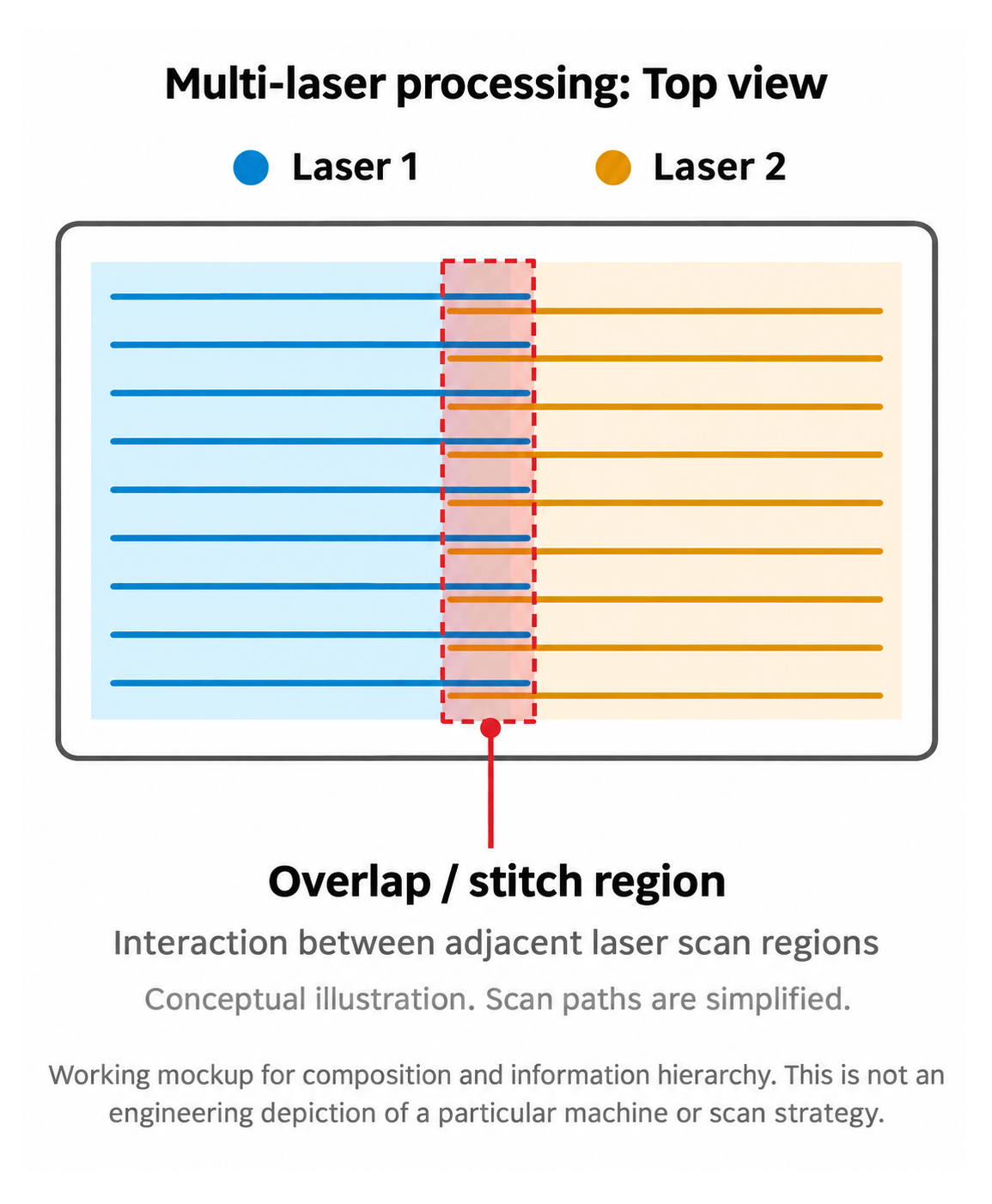
Singh made the consequence explicit in his keynote: when moving from one laser to four or twelve, fatigue, not static properties, is what changes. An aligned discontinuity at a stitch line may not move the average tensile strength, but it can control fatigue life. Qualifying a multi-laser system therefore means showing that each laser produces acceptable material, and that overlap regions and scan-strategy transitions meet the same acceptance criteria as the rest of the build.
Testing this at the pace at which machines evolve is its own challenge. Jorge Mireles (AconityUS) presented ultrasonic fatigue testing as a screening tool for L-PBF process changes. It reaches very high cycle counts in hours rather than weeks. In a single build of AlSi10Mg specimens, the low-stress failures clustered on one side of the build plate, consistent with gas-flow effects, and the same trend appeared in conventional ASTM E466 specimens.
He was clear that the method does not replace E466 testing for design allowables. Its value is in identifying which process or configuration changes warrant that deeper testing.
The productivity gains are real, but each new laser configuration, layer thickness, or powder cut is a change that needs its own qualification evidence.
How do manufacturers qualify supplier changes without starting over?
A production program may need a second material source, a replacement machine, or an updated process setting. Treating every change as entirely new can add substantial time and expense. At ICAM, I heard growing interest in methods that distinguish changes that alter part performance from changes that stay within a proven operating range.
Kiley Versluys (Divergent) described an approach based on process definitions and “substitutability” against a defined suite of material properties. A process definition covers the raw material specification, printer configuration, parameters, and heat treatment. Any change creates a new definition, which must meet the same set of material properties as before.
The useful question is whether the new configuration can meet the same requirements, with enough data to substantiate the change. The answer depends on what the program has already measured, how variation is controlled, and the sensitivity of the part to any remaining differences.
This also connects with the GOTHAAM project, led by General Atomics Aeronautical Systems, which aims to generate MMPDS-compliant allowables for high-strength aluminum. Equispheres participates alongside other powder producers, including Valimet and Toyal America. Collaborative qualification programs can help generate a more consistent evidence base across machine sizes, feedstock lots, and production settings. They do not make all configurations interchangeable, but they can reduce duplicated work and establish clearer paths for evaluating changes.
For powder producers, including us, this creates a clear responsibility: characterize the material consistently, document the relevant variation, and participate early in the qualification strategy. A second powder source is most useful when its performance can be evaluated against requirements that manufacturers have already defined.
Qualifying a production process means understanding which changes affect part performance and having evidence to manage those changes.
What I would prioritize when planning a qualification program
Based on the discussions at ICAM, I would focus on four considerations when developing an AM qualification strategy:
- Anticipate changes in the production environment. Identify likely changes in machines, feedstock suppliers, and processing conditions early in the qualification plan. RTX’s Q3+ framework shows the value of deciding in advance which level of qualification each type of change triggers.
- Understand which variables affect part performance. Determine which material and process characteristics influence the properties that matter most for the application. The JMADD and Boeing results suggest that feedstock lot variation deserves as much attention as machine variation.
- Evaluate variability, not just average properties. Consider distribution of discontinuities, surface quality, fatigue performance, and post-processing response where relevant. In multi-laser builds, overlap regions can control fatigue life without changing average tensile results.
- Establish a change-control strategy. Define the evidence needed to introduce a new powder lot, approve an alternative supplier, or adjust process parameters. Link it to the material specification and the PCD, so the same changes are controlled at the powder supplier and at the part producer.
Qualification must keep pace with industrial AM
I left ICAM encouraged by the direction of the conversation. There is still important development ahead in lasers, process control, and materials, but there is also a more mature discussion about how manufacturers establish confidence in the process and maintain it through production changes.
The next step is to turn that discussion into usable datasets that include feedstock lot variation, validated process windows, discriminating material specifications, and practical equivalency methods. If machines continue to change at the pace RTX described, I expect this work to strongly influence how quickly metal AM becomes a repeatable production option across machines, feedstock lots, and suppliers.
Stay informed about production AM
For more technical insights about production additive manufacturing, qualification, and materials research, subscribe to Equispheres updates.