One of the most practical Additive Manufacturing military applications is the production of critical repair parts in remote and contested environments. Fieldmade is making that happen with deployable AM units that produce viable spare parts, using non-explosible aluminum powder as one of their feedstocks.
Canada and Norway share an intimidating operating challenge.
Both countries manage geographies characterized by harsh climates. Long coastlines and large remote areas can push people and equipment far from traditional maintenance hubs. Canadian and Norwegian mining and energy operators share these constraints, as do our countries’ defence establishments.
In response to this challenge, the Norwegian company Fieldmade is making advances in AM technology to extend supply lines to the point of need.
Why spare parts matter in remote and contested environments
Arctic and maritime contingents depend on equipment availability over long distances. A conventional spare-parts model assumes that you can carry what you need or get it delivered in time to keep equipment operational.
However, in remote operations, it is not always realistic to carry spares for everything, and equipment failures are unpredictable, so no subset of parts will meet all needs.
Coast guard vessels and naval assets often operate beyond easy reach of conventional maintenance networks. In addition, replacement parts for legacy systems may be hard to source.
A part that arrives in two weeks could still be operationally too late. If a single component keeps a support asset offline, the effect can cascade quickly.
That operating reality is why deployable manufacturing is drawing interest from defence planners, government stakeholders, and companies working on sustainment.
The vision of Additive Manufacturing (AM) has always included the idea of making parts on demand where they are needed. For many applications, that promise has taken longer to materialize than the industry expected. Equipment, materials, process control, and quality assurance all had to catch up.
NOMAD®03, developed by Fieldmade, is one of the clearest examples of that vision moving into practical use. The system is a deployable shelter that expands out from a compact footprint into a fully outfitted microfactory to support metal AM in remote environments.
Multiple NOMAD 03 units are already up and running in hard-to-reach areas. They enable the entire workflow, so when an operator receives a broken part, they can reverse engineer the fix, prepare digital models, print replacements under climate-controlled conditions, and verify that the part is suitable for the job at hand.
In field operations, that capability is critical for reducing downtime and preventing a single broken component from sidelining equipment for days or weeks while teams wait for resupply.
Spare parts manufacturing as a readiness enabler
A large share of public discussion focuses on broad future-state possibilities such as drones, aerospace structures, and weapons components. Those applications are important, but repair and sustainment deserve attention.
The ability to restore operational capability with a locally produced part can have a direct impact on mission continuity.
NOMAD 03 is built to produce functional replacement parts in remote environments, giving operators a way to restore equipment availability without waiting for conventional resupply. In some situations, that means producing a durable end-use replacement. In others, it can mean manufacturing a bridge part that returns a system to service and keeps operations moving until the standard replacement arrives through the usual supply chain.
Aluminum is an important material in the field because so many parts and assemblies rely on it. It offers low weight, useful thermal properties, and broad relevance across defense, maritime, and industrial systems.
At the same time, aluminum has posed real challenges in metal AM. Conventional aluminum powders can introduce significant storage, handling, and safety burdens. They also demand tightly controlled process conditions if users want consistent output.
Field deployment magnifies those constraints. A lab or industrial facility can build procedures and infrastructure around a reactive material. However, a ruggedized deployable system has to contend with variable surroundings, operator workload, maintenance constraints, and limited support infrastructure. Materials that work well in a tightly managed indoor setting are not automatically a good fit for remote production.
To produce repair parts in remote and contested environments, you need a material that behaves reliably under variable operating conditions, minimizes unnecessary handling burden, and supports repeatable results.
In AM, the feedstock is a process enabler. Good material selection can improve throughput and repeatability, creating a more reliable process.
How safer aluminum changes what is possible in the field
Equispheres NExP-1 was developed to work with those realities. The powder is non-explosible per ASTM E1226 and non-combustible under the applicable UN flammable solids test method, which reduces one of the major barriers associated with aluminum powder handling.
It also supports a cleaner operating environment because the material has very low dust compared with conventional powders.
Remote manufacturing puts pressure on process robustness. Operators need a powder that behaves consistently, tolerates realistic environmental variation, and supports reliable printing without demanding constant intervention.
NExP-1 is designed with spherical particles, low fines, and strong flow characteristics that support repeatable printing behavior.
In less controlled environments, powder performance can degrade faster when materials pick up moisture from the air. NExP-1 has lower moisture pickup than conventional aluminum powders because of its morphology and surface characteristics. That helps preserve more stable behavior through storage, handling, and production.
So much more than a machine in a shipping container
Deployable manufacturing only works when the surrounding infrastructure is engineered for it. Printing metal parts in the field still requires a controlled process, post-processing capability, and a workflow that operators can execute under real conditions.
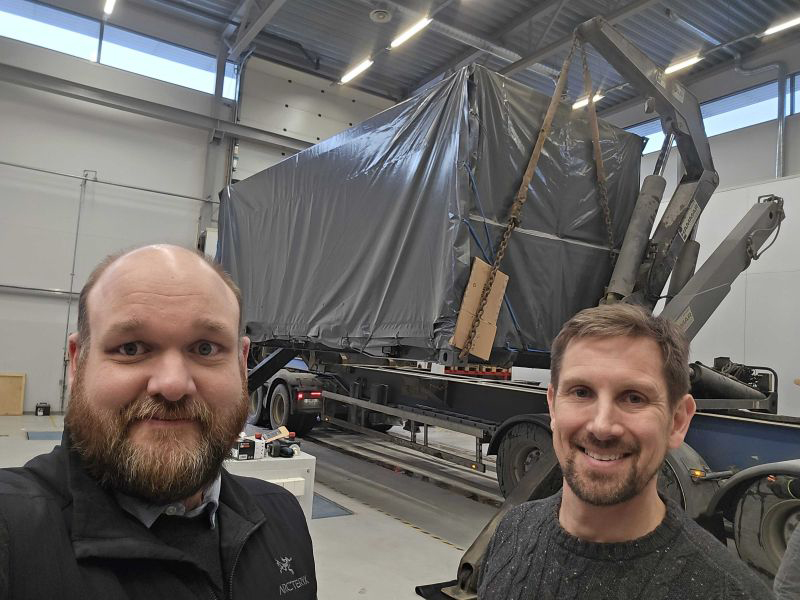
Fieldmade has spent years focusing on that challenge. Its NOMAD platform packages the surrounding capabilities needed to turn a printer into a field-ready capability. I was able to visit Fieldmade at a time when they were receiving a new NOMAD 03 for assembly, and it was incredible to see the work they are doing first-hand.
Military sustainment units are looking for tools that fit existing operational realities. The value of a ruggedized microfactory, paired with a safer aluminum powder and a practical reverse-engineering workflow, is easy to understand in that context.
Deployable metal Additive Manufacturing does not solve every supply-chain problem, but it gives operators a critical option when time, distance, and uncertainty all work against conventional repair models.
Today, our collaboration focuses on aluminum, with an eye toward future materials needs in naval and maritime applications. Equispheres is evaluating how its aluminum and copper capabilities could support additional alloys, including bronzes and other materials.
The Fieldmade and Equispheres collaboration points toward a more practical model of deployable aluminum part production close to the point of need, grounded in sustainment and readiness. It also reflects a maturing view of additive adoption. Process capability, material behavior, and operating context all matter. None of them can be treated as secondary.
For Canada and Norway, the relevance extends beyond a single platform or one use case. Remote operations are a permanent condition, and equipment will keep breaking far from the nearest warehouse. Ships will keep operating long distances from traditional maintenance support. Governments will keep looking for ways to increase resilience without carrying every imaginable spare.
Deployable Additive Manufacturing will not replace the supply chain, but it can ease pressure on it in places where that pressure is hardest to absorb.