An award-winning e-motor housing shows how automotive Additive Manufacturing is enabling new approaches to thermal management.
Industry events like RAPID + TCT provide a useful snapshot of how automotive Additive Manufacturing is evolving and highlight its performance potential.
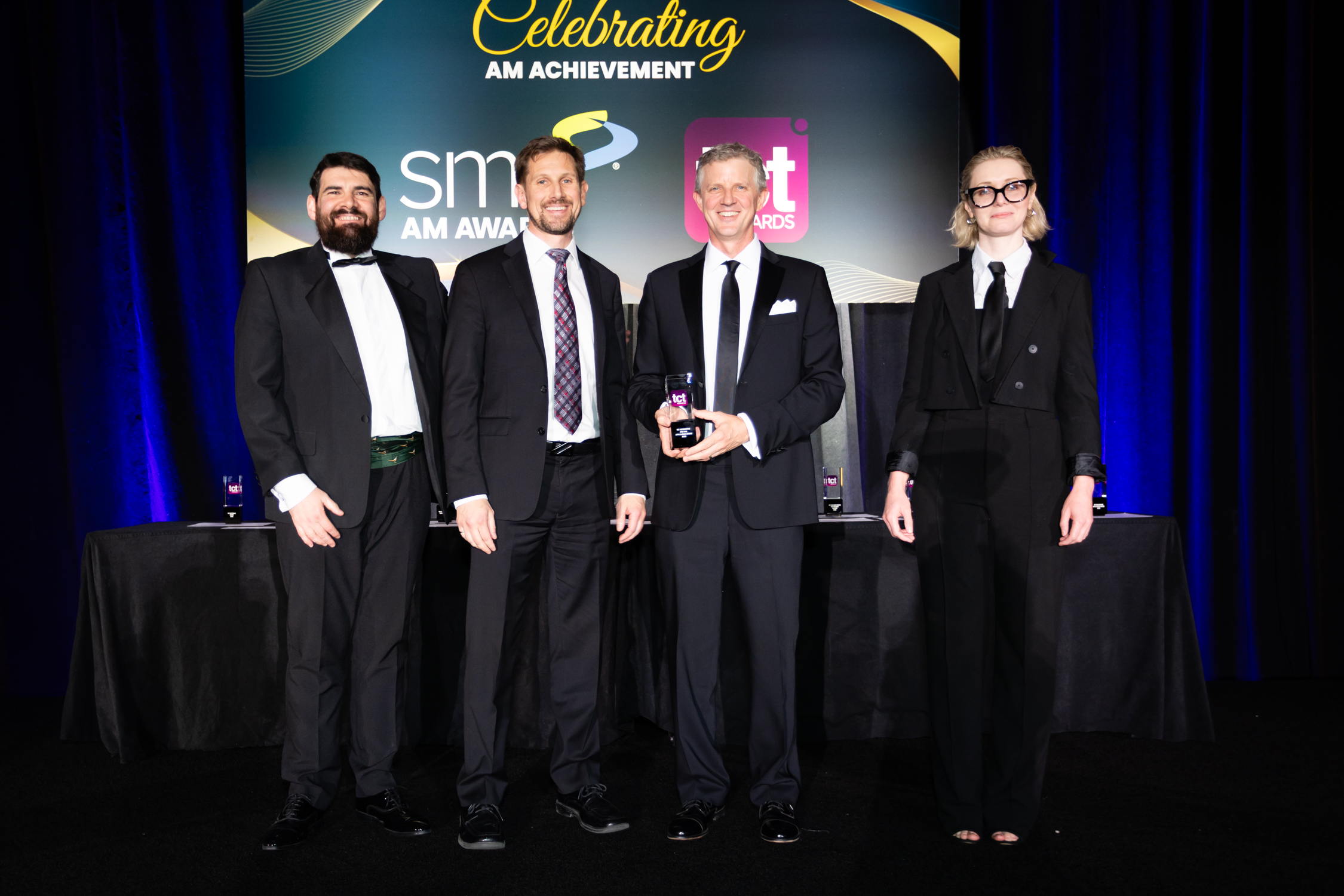
When the 2026 TCT Awards were announced in Boston, I was there to see the e-motor housing we developed with Martinrea International win the category of Automotive & Rail Application. This recognition was particularly rewarding given the amount of work that went into getting the part to behave the way it does.
This work was previously presented at AMUG 2025, where it won the Advanced Concepts Category. The concept, which integrates passive and active cooling into a single aluminum structure, is now being progressed toward other similar production applications in automotive and aerospace.
Application context: Thermal management in electric drivetrains
Thermal management remains a central challenge in electric motor design, as well as many other subsystems and components in modern vehicles. Existing solutions often rely on increased coolant flow, larger pumps, or external heat transfer components, each of which introduces trade-offs in efficiency, packaging, or system complexity.
AM enables more complex internal geometries, allowing thermal management features to be incorporated directly into the structure of a part. This creates opportunities to improve heat transfer while maintaining or reducing overall system size.
The approach: Embedding a vapor chamber within the structure
The winning part was printed on an AconityTWO system using laser powder bed fusion (LPBF). Parameter development focused on producing dense structural regions and porous wick regions within the same layer.
Incomplete melt strategies were applied in the wick region to create interconnected porosity. Dense regions were produced using full-melt parameters.
Process consistency depended on stable powder spreading and controlled melt pool behavior. Variations in energy input affected pore structure within the wick and, in turn, fluid transport performance.
Technical considerations: process and material alignment
Producing both fully dense material and a functional porous structure in the same part requires careful coordination between design, process parameters, and material behavior.
Highly complex lattice or structure geometries can be used to create wicking surfaces, but they often result in inefficient laser paths and significantly increased build times. In this case, the structure was designed to balance functionality with process efficiency, avoiding features that would limit scalability due to excessive print time.
In LPBF, the interaction between laser energy, scan strategy, and powder characteristics determines melt pool stability and consistency. Variations in these factors can affect both structural integrity and the formation of fine features.
For applications like this, consistent powder behavior is particularly important. Stable spreading, predictable melting, and uniform energy absorption support both high-density regions and controlled porosity within the same build.
These factors also influence build rate and repeatability, which are key considerations for Additive Manufacturing automotive applications where cost and consistency are critical.
Results: improved thermal performance
Using the developed approach, simulations of the demonstrator part showed measurable improvements in cooling performance:
- More than 60% reduction in pressure drop
- 39°C reduction in winding temperature
These results reflect the effect of integrating passive cooling directly into the component, reducing reliance on external systems and improving heat distribution across the part.
In electric drivetrains, improvements in thermal management can contribute to increased efficiency, reduced energy consumption, and longer component life. The TCT Award evaluation included:
- Performance relative to conventional cooling designs
- Integration within an existing production geometry
- Ability to produce both porous and dense features in a single build
- Use of commercially available LPBF systems and aluminum alloys
No additional assemblies or unusual post-processing steps were required to implement the cooling architecture.
The TCT Award highlights how Additive Manufacturing is applied to solve practical engineering challenges in an industrial context.
While this specific design is not intended for production, the underlying approach has proven effective from a performance standpoint.
Broader implications for automotive Additive Manufacturing
Projects like this illustrate how automotive Additive Manufacturing is progressing.
Rather than focusing solely on geometric complexity, there is increasing emphasis on integrating functionality (such as cooling, fluid flow, or lightweighting) directly into parts. This shift changes how components are designed and how systems are optimized.
As machine capabilities and process control continue to improve, the ability to combine multiple material states and functions within a single build will become more accessible. For automotive applications, this opens the door to new approaches that balance performance, cost, and manufacturability.
In that context, the significance of this work is less about the individual component and more about demonstrating how Additive Manufacturing automotive applications can move from concept to implementation, using a combination of design, process development, and materials to deliver measurable results.
Want to stay updated on Equispheres’ latest innovations in Additive Manufacturing materials and applications? Join our mailing list to receive our quarterly newsletter and technical updates.
About the TCT Awards
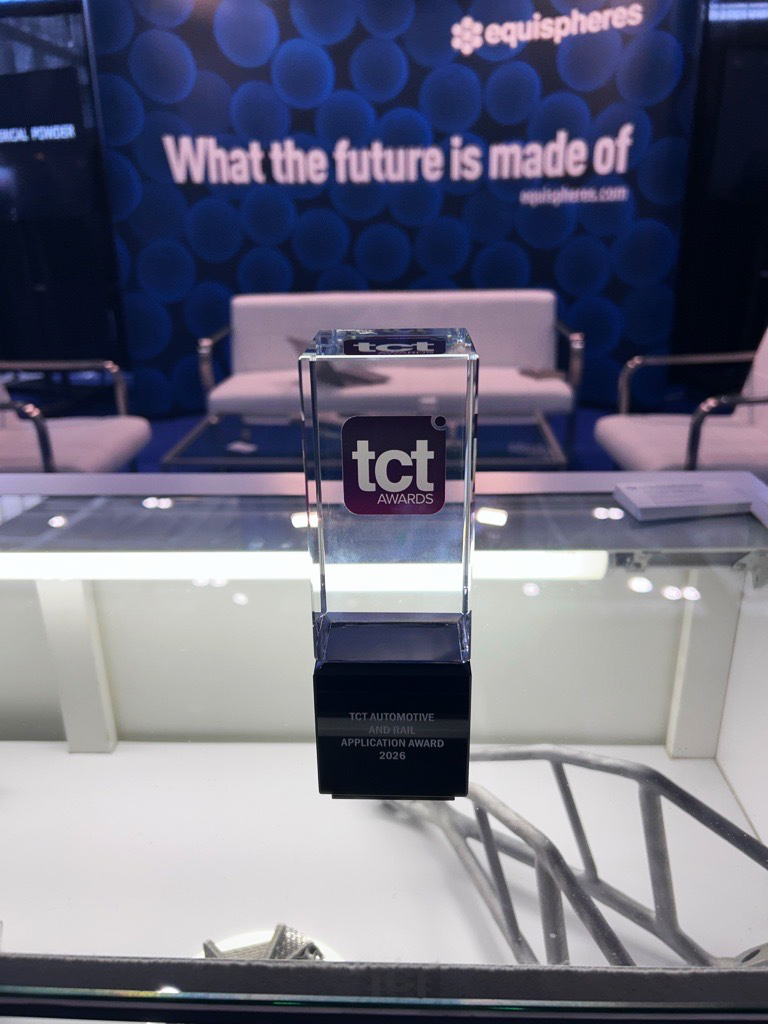
The TCT Awards recognize achievements across Additive Manufacturing technologies, materials, and applications. The Automotive & Rail category focuses specifically on implemented or implementation-ready solutions that demonstrate measurable impact in mobility-related applications. Submissions are evaluated based on criteria such as innovation, application relevance, and performance outcomes, with an emphasis on how Additive Manufacturing is being used to address practical engineering and production challenges.
About the collaborators
Equispheres develops breakthrough technologies for the production and deployment of aluminum powders in Additive Manufacturing (AM). Leveraging our patent-pending technology and process expertise, we strive to eliminate the performance and economic obstacles limiting the full potential of metal AM at industrial scale.
Martinrea International Inc. (TSX: MRE) is a leader in the development and production of quality metal parts, assemblies and modules, fluid management systems, and complex aluminum products focused primarily on the automotive sector.